

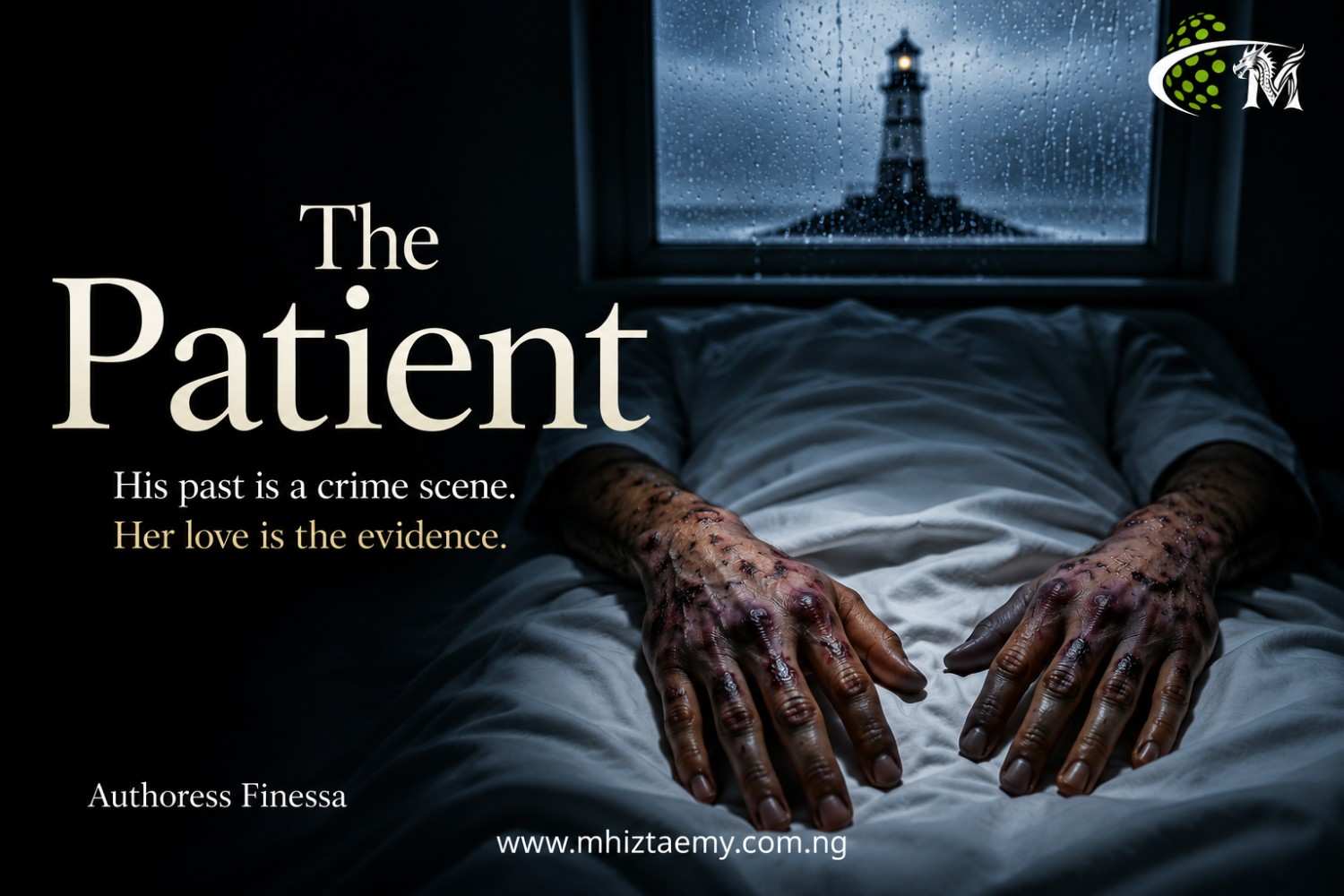
THE PATIENT
The Patient – Chapter 1
Theme: the violence of willful blindness. How much truth are we willing to sacrifice for love?
Settings: port Amber, Port Amber, a fictional gray coastal city. St. Dymphna’s Hospital. The ghost town of Blythe in the northern hills.
Genre: dark romantic suspense•••••
Mystery:What really happened in Blythe? Where is Clara? And is the man in Willa’s care a survivor, a savior, or a monster?
Tags: gothic romance, missing child, anti heroine protagonist, forced proximity••••
® FINESSA.
♣♣♣♣♣♣♣♣♣♣♣♣♣♣♣♣♣♣♣♣♣♣♣♣♣♣♣♣♣♣♣♣♣♣♣
The Arrival
The rain had not stopped for three days.
Related Posts
Willa counted the hours the way some people counted sheep, marking the passage of time by the drum of water against the window of the trauma unit, by the slick sheen of it on the asphalt four floors below, by the way the lights of Port Amber blurred and bled into the harbor like wet ink on paper. She had been on shift for eleven hours. Her scrubs smelled of antiseptic and exhaustion. Somewhere down the hall, a man was screaming at a nurse about his prescription, and the vending machine on the second floor was broken again, and she had not eaten since the granola bar she’d choked down at six that morning, and none of it mattered, because the radio on her hip had just crackled to life.
“Incoming trauma. Male. Estimated mid-thirties. Multiple lacerations, possible internal bleeding, severe head trauma. ETA four minutes.”
She was already moving.
The emergency bay doors opened with the wet gasp of hydraulics, and the night air rushed in, carrying the salt-fish smell of the harbor and the cold, metallic scent of rain. The ambulance lights painted the walls in urgent reds and whites. Willa fell into step beside the gurney as it slammed through the doors, her hands already reaching for the rail, her eyes already scanning.
“Talk to me,” she said.
“Found in a vehicle off County Road 17, about three hours north,” the paramedic said, his voice clipped and rapid. “Single-vehicle collision, but that’s not the whole story. He’s got wounds that aren’t from the crash. Defensive wounds, maybe. Someone worked him over good before he ever got behind the wheel.”
Willa looked down at the man on the gurney, and for a moment—just a fraction of a heartbeat—her hands stilled.
He was broad across the shoulders, the kind of body that spoke of physical labor or violence or both. His face was a ruin of bruises and dried blood, one eye swollen shut, a deep gash across his left cheekbone that would scar no matter how carefully she stitched it. His dark hair was matted with blood and rain. But it was his hands that caught her. His hands that held her gaze like a hook in soft flesh.
The knuckles were split and raw. Old scars, new wounds, the skin torn and crusted over. A fighter’s hands. Hands that had hurt and been hurt. Hands that had known violence intimately and for a long time.
She knew those hands. Not these exact ones. But she knew the type. She had held hands like these before. She had kissed them, bandaged them, flinched from them. She had told herself she would never touch them again.
And yet here she was.
“BP’s dropping,” she said, her voice steady, her training a wall she could hide behind. “Let’s get him into trauma one. I want a CT scan ordered, head and abdomen. Page neurology. And someone find out who he is.”
“There’s no ID,” the paramedic said. “No wallet, no phone, no plates on the vehicle. This guy’s a ghost.”
Willa looked down at the man again. His one unswollen eye was closed, his breathing shallow and ragged. He looked like a man who had been running from something. Or toward something. Or both.
“Then we’ll call him John Doe,” she said. “And we’ll keep him alive until he can tell us otherwise.”
—
The first hour was a blur of blood and beeping monitors and the controlled chaos of a trauma team doing what they did best. Willa worked with her hands and her voice and the part of her brain that knew exactly what to do without her having to think about it. IV lines. Pressure. Fluids. The cold, clean bite of a scalpel. The hiss of the ventilator. She was good at this. She had always been good at this. Fixing broken things was the only skill she had ever truly trusted.
But even in the storm of it, she kept glancing at his hands.
When the patient was finally stable—intubated, sedated, stitched—Willa stood alone in the quiet of the trauma bay, her gloves still on, her heart still beating too fast. The monitors sang their steady, reassuring songs. The man on the bed was no longer dying. He was no longer living either, not really. He was suspended somewhere in between, in that gray, liminal space where the body fought its silent war and the mind went dark.
She should have left. Her shift had ended two hours ago. There was paperwork. There was a cold cup of coffee in the break room. There was the small, empty apartment on Meridian Street that she paid too much for and spent too little time in.
Instead, she pulled up a chair.
She didn’t know why. Or she did know why, and she didn’t want to name it. Not yet. Not now.
His hands lay motionless on the white sheet, palms up, fingers slightly curled, as if he had been holding something and it had been taken from him. The split knuckles. The scars, some old and silvered, some fresh and purple. Willa reached out, her gloved fingers hovering just above his skin, not quite touching.
She thought of her ex-husband. The way his hands had looked after a fight. The way they had looked before one, too. The way she had always told herself the same lie, the one that began with he’s different and ended with a locked bathroom door and the taste of blood in her mouth.
This man was not him. This man was a stranger, a John Doe, a body on a gurney with no name and no past and no promises to break. And yet something in her recognized something in him. A kinship of damage. A shared language of scars.
She pulled her hand back.
“Who are you?” she murmured.
The man did not answer. The monitors beeped. The rain kept falling.
And then, so quietly she almost didn’t hear it, he spoke.
“Clara.”
A name. A girl’s name. A child’s name. It fell from his cracked, swollen lips like a drop of water from a leaking faucet, small and fragile and devastating.
Willa went very still.
“Clara,” he said again, and this time there was something in his voice that made her chest ache. Fear. Longing. Grief. All of it, wrapped in a single word.
She didn’t know who Clara was. A daughter. A sister. A victim. A ghost. But she knew, with the cold certainty of a woman who had learned to read danger the way other women read romance novels, that this name—this single, trembling name—was the key to everything.
She should call the police. The detectives had already been notified; they were waiting for him to wake up. This was evidence. This was a lead.
Willa looked at the man’s hands again. The fighter’s hands. The hands that had done something terrible or survived something terrible or both.
She didn’t call anyone.
She sat in the chair, and she listened to the rain, and she waited for him to speak again.
—
Captivating right?

5 Comments
Yea.really captivating.good work
Wow this amazing keep it up
Who else understand this story?
So interesting, can’twait for the next chapter.
Well am catching up but lets it be long a little