

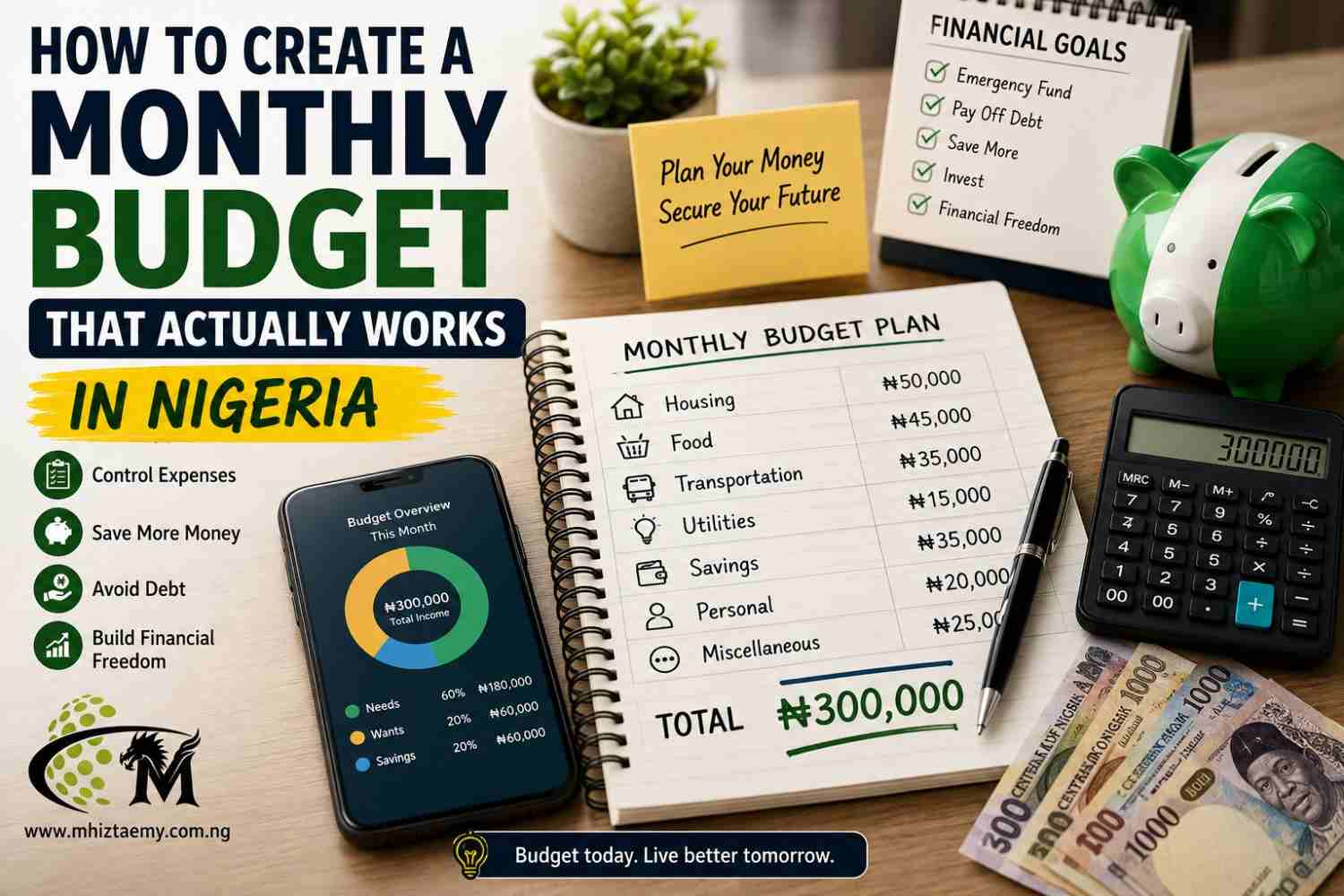
Managing money in Nigeria can feel difficult when your income arrives and seems to disappear almost immediately. Rent, food, transportation, data, electricity, subscriptions, family responsibilities and unexpected expenses can quickly consume a salary before the month is halfway over.
A monthly budget can change that pattern. It gives every naira a purpose before you start spending, helping you see where your money goes and where adjustments are needed. You do not need a huge salary to start budgeting, and you do not need complicated financial software either.
MhiztaEmy will show you how to create a monthly budget that fits your income, lifestyle and financial goals in Nigeria. You will also see how to divide your salary, manage irregular expenses, reduce unnecessary spending, build savings and adjust your budget when prices change.
What Is a Monthly Budget?
A monthly budget is a simple financial plan that shows how much money you expect to receive during a month and how you intend to use it. Your plan can include household expenses, transportation, food, savings, debt payments, investments, personal spending and emergency expenses.
The purpose is not to prevent you from enjoying your money. Instead, a good budget helps you decide what deserves your money before other expenses consume it.
Someone earning ₦150,000 per month may have a completely different budget from someone earning ₦500,000. The most useful budget is one that reflects your actual income and expenses instead of copying another person’s financial plan.
Why Many Monthly Budgets Fail
Many people create a budget at the beginning of the month but stop following it after a few days. This usually happens because the budget looks good on paper but does not reflect real spending patterns.
An unrealistic food allowance, forgotten subscriptions, rising transportation costs or frequent transfers to other people can quickly push spending beyond the original plan. Some people also leave no room for unexpected expenses, forcing them to borrow money when something goes wrong.
Another problem is creating too many restrictions. A budget that leaves no room for personal enjoyment can become difficult to maintain. A flexible plan that includes savings, necessities and controlled personal spending is usually easier to continue.
Step 1: Calculate Your Total Monthly Income
Start with the money you realistically expect to receive during the month. Salary earners can use their expected take-home pay rather than their gross salary because deductions such as tax, pension and other contributions may reduce the amount that reaches their account.
Related Posts
- Why Many Young Nigerians Are Turning to Digital Savings Apps: The Shift Toward Smarter Money Management
- 10 Money Habits Secretly Keeping Many Nigerians Poor in 2026
- How to Build Financial Discipline as a Young Nigerian and Stop Living Paycheck to Paycheck
- 13 Smart Money Rules Every Nigerian Student Should Know Early
- How to Build Multiple Streams of Income in Nigeria and Achieve Financial Stability
- How to Stop Living From Salary to Salary: 12 Smart Ways to Take Control of Your Money
- How to Manage Your Salary Wisely in Nigeria and Still Have Savings Left
- How Nigerians Are Surviving the High Cost of Living Without Going Broke
People with freelance income, business income or multiple sources of income should use a conservative estimate. Avoid building your monthly spending around money you have not received yet.
Here is a simple example:
| Income Source | Expected Amount |
|---|---|
| Salary | ₦250,000 |
| Freelance work | ₦50,000 |
| Side business | ₦30,000 |
| Total expected income | ₦330,000 |
If your freelance income is inconsistent, you can build your basic budget around your regular salary and treat additional income separately.
This makes your finances more stable because your essential expenses are not dependent on uncertain income.
Step 2: List Your Fixed Monthly Expenses
Fixed expenses are payments that usually remain similar from month to month. Examples can include rent contributions, school fees paid monthly, loan repayments, internet plans, insurance payments and certain subscriptions.
Write down each recurring expense and its estimated amount. Checking your bank statements and transaction history can help you identify payments you may have forgotten.
A sample list could look like this:
| Expense | Monthly Amount |
|---|---|
| Rent contribution | ₦50,000 |
| Internet | ₦15,000 |
| Loan repayment | ₦30,000 |
| Electricity contribution | ₦15,000 |
| Subscriptions | ₦5,000 |
| Total | ₦115,000 |
Knowing these expenses first shows how much of your income is already committed before you consider food, transport and personal spending.
Step 3: Track Variable Expenses
Variable expenses can change from month to month. Food, transportation, electricity, airtime, entertainment and shopping often fall into this category.
Tracking these expenses for at least one month can reveal spending patterns you may not notice during everyday transactions. A few small purchases each day can add up to a surprisingly large amount by the end of the month.
Try recording every expense, including small payments. A ₦1,000 purchase may seem insignificant at the time, but ten similar purchases can become ₦10,000.
You can use a notebook, spreadsheet, budgeting app or notes application on your phone. The tool matters less than consistently recording your transactions.
Step 4: Separate Needs From Wants
A useful Nigerian household budget should distinguish between expenses you must pay and expenses you can reduce when income becomes tight.
Needs may include food, housing, transportation, electricity, healthcare, essential communication and debt repayments. Wants can include frequent restaurant meals, entertainment, premium subscriptions, impulse shopping and non-essential upgrades.
This does not mean every want must disappear. Instead, your budget should make room for enjoyable spending after your important financial responsibilities have been covered.
Ask yourself a simple question before making a purchase: “Does this expense support my current priorities, or can I postpone it?”
That question can prevent many impulse purchases without making your monthly budget feel restrictive.
Step 5: Choose a Budgeting Method That Fits You
Different budgeting methods can work for different people. The best system is one you can follow consistently.
The 50/30/20 Budget Rule
The 50/30/20 method divides income into three broad categories: needs, wants and savings or debt repayment.
A simplified example using ₦300,000 would look like this:
| Category | Percentage | Amount |
|---|---|---|
| Needs | 50% | ₦150,000 |
| Wants | 30% | ₦90,000 |
| Savings/Debt | 20% | ₦60,000 |
| Total | 100% | ₦300,000 |
This structure is easy to understand, but Nigerian living costs can make the percentages difficult to follow exactly. Someone paying high rent or supporting family members may need to allocate more than 50% to necessities.
Treat these percentages as a starting point rather than a rigid rule.
The Zero-Based Budget
A zero-based budget gives every naira a planned purpose.
Suppose your monthly income is ₦300,000. You could assign ₦140,000 to necessities, ₦40,000 to transportation, ₦35,000 to food, ₦30,000 to savings, ₦25,000 to debt repayment, ₦15,000 to personal spending and ₦15,000 to miscellaneous expenses.
The total allocation equals ₦300,000. This does not mean your bank account must reach exactly zero. It means there is a plan for your available income instead of leaving money without a purpose.
This method can be useful if you want tighter control over your spending.
Step 6: Create a Nigerian Monthly Budget Example
Let’s assume someone earns ₦300,000 per month.
| Budget Category | Amount |
|---|---|
| Rent contribution | ₦50,000 |
| Food | ₦45,000 |
| Transportation | ₦35,000 |
| Electricity | ₦15,000 |
| Data and airtime | ₦10,000 |
| Family support | ₦20,000 |
| Debt repayment | ₦25,000 |
| Savings | ₦35,000 |
| Personal spending | ₦20,000 |
| Emergency fund | ₦20,000 |
| Miscellaneous | ₦25,000 |
| Total | ₦300,000 |
This example is not a universal formula. Housing costs, family responsibilities, transportation needs and income levels differ widely across Nigeria.
Someone living in Lagos may spend more on transportation or rent than someone living in another city. A person working from home may have lower transportation costs but higher electricity or internet expenses.
The important idea is to create categories based on your own financial situation.
Step 7: Budget for Food Properly
Food can become one of the largest monthly expenses in a Nigerian household. Prices can also change, making it difficult to maintain the same food budget throughout the year.
Create a weekly food allowance instead of simply assigning one large monthly amount. A ₦48,000 monthly food budget could become approximately ₦12,000 per week.
Planning meals before shopping can also reduce impulse purchases. Buying commonly used household items in sensible quantities may help reduce repeated small purchases.
Eating outside frequently can also affect your budget. If you spend ₦3,000 on lunch several times each week, calculate the monthly total before deciding how often to continue.
Step 8: Include Transportation Costs
Transportation deserves its own category because commuting can consume a large portion of income.
Estimate your average daily transportation cost and multiply it by the number of days you usually travel each month. Add occasional trips, ride-hailing expenses and transportation for errands.
Someone spending ₦2,000 per workday on transportation could spend around ₦40,000 across 20 working days. That amount should be visible in the budget rather than treated as an unexpected expense.
People who work remotely can assign the money saved from commuting to another financial priority, such as savings, debt repayment or investments.
Step 9: Pay Yourself First
Saving whatever remains after spending often produces poor results because there may be little or nothing left at the end of the month.
A better system is to decide on your savings amount before discretionary spending begins. Once your income arrives, transfer the planned amount into a separate savings or investment account.
Someone earning ₦250,000 and saving ₦25,000 monthly would accumulate ₦300,000 over twelve months, excluding interest or investment returns.
Starting with a small amount is better than waiting until you can save a large percentage of your income.
Step 10: Build an Emergency Fund
Unexpected expenses can destroy an otherwise healthy budget. Car repairs, urgent travel, medical bills, family emergencies, job loss or major household repairs can require money outside your normal monthly spending.
An emergency fund provides a financial cushion for these situations. Start with a small target if your current income is limited, then increase the amount gradually.
A first target could be ₦100,000, followed by one month of essential expenses and eventually several months of essential living costs.
Keep emergency money separate from your everyday spending account so it is less tempting to use for entertainment or impulse purchases.
Step 11: Create a Budget for Irregular Expenses
Some expenses do not appear every month but still need to be planned.
Examples include annual rent, school expenses, birthdays, festive travel, vehicle maintenance, professional fees and major household purchases.
Suppose your annual insurance payment is ₦120,000. Dividing that amount by 12 gives ₦10,000 per month.
Saving ₦10,000 every month creates ₦120,000 over a year, meaning the annual payment does not arrive as a financial shock.
This technique can also work for December expenses, school fees and other predictable yearly bills.
Step 12: Handle Family Support Within Your Budget
Family support is an important part of financial planning for many Nigerians. Problems can arise when support is given without an amount being planned.
Create a monthly family-support category if you regularly send money to relatives. Assign an amount that your income can sustain.
An emergency request may require flexibility, but regular support should ideally have a defined limit. This allows you to help others without repeatedly sacrificing rent, savings, debt payments or essential expenses.
Clear financial boundaries can make your monthly budget more sustainable.
Step 13: Control Bank Charges and Small Digital Payments
Small financial charges can quietly reduce the amount available for your priorities. Transfer fees, ATM charges, card-related costs, subscriptions and repeated small digital purchases can accumulate over time.
Review your bank statements at the end of each month. Look for recurring charges and services you no longer use.
Removing even ₦5,000 in unnecessary monthly expenses can free up ₦60,000 over a year. That money could instead go toward savings, debt repayment or another financial goal.
Step 14: Use Separate Accounts or Wallets
Keeping all your money in one account can make it easier to overspend. Separate accounts or savings spaces can help create boundaries between spending and saving.
You might keep your regular spending money in your main account while placing emergency savings and long-term savings elsewhere.
Some Nigerian banks and fintech apps provide savings features that can help users separate funds for different goals. Always check fees, terms, withdrawal conditions and applicable protections before choosing a financial service.
Step 15: Review Your Budget Every Week
A monthly budget should not be created once and forgotten.
Spend a few minutes each week checking your actual spending against your planned amounts. Early review allows you to notice overspending before it becomes a major problem.
Suppose your entertainment budget is ₦15,000 and you have already spent ₦12,000 during the first half of the month. You can reduce additional entertainment spending rather than discovering the problem at the end of the month.
Weekly reviews make your budget more responsive to real-life spending.
Step 16: Adjust Your Budget When Prices Increase
Inflation can make an old budget unrealistic. Food, transportation, electricity and household expenses may rise while your income remains unchanged.
Avoid abandoning your budget when prices change. Instead, review each category and decide where adjustments can be made.
You may reduce discretionary spending, change shopping habits, renegotiate certain services or temporarily lower a non-urgent savings target while maintaining some level of saving.
A useful budget is flexible enough to respond to changes without losing sight of your larger financial goals.
Step 17: Give Every Extra Income a Purpose
Bonuses, freelance payments, business profits, gifts and other unexpected income can create opportunities to improve your finances.
Avoid automatically treating extra income as spending money. Decide in advance how additional money will be divided.
An example could be:
| Extra Income Allocation | Percentage |
|---|---|
| Emergency savings | 30% |
| Debt repayment | 30% |
| Investment | 20% |
| Personal spending | 10% |
| Family support | 10% |
The percentages can change depending on your financial situation. Someone carrying expensive debt may place more money toward repayment, while someone without debt may increase savings or investments.
A Simple Monthly Budget Formula
A straightforward budgeting formula can help you organise your money:
Monthly Income − Essential Expenses − Savings − Debt Payments − Personal Spending = Remaining Balance
Your target should be to avoid having your expenses consistently exceed your income.
If the calculation produces a negative amount, something needs to change. Look at discretionary spending first, then review recurring expenses and other categories that can be adjusted.
If you consistently have a large amount left unallocated, give that money a purpose instead of allowing it to disappear through unplanned spending.
Common Budgeting Mistakes to Avoid
Creating a Budget Based on Your Ideal Lifestyle
Your budget should reflect what you actually spend, not what you wish you spent.
A person who normally spends ₦60,000 on food but writes ₦20,000 in the budget without changing their shopping habits will probably exceed the target.
Start with your current spending, then make gradual adjustments.
Forgetting Irregular Expenses
Annual bills can create major financial pressure when they are ignored during monthly planning.
Add a small amount every month toward predictable future expenses. This turns large yearly payments into smaller monthly commitments.
Setting Savings Targets That Are Too High
Saving 50% of your income may sound impressive, but it may not be realistic if your essential expenses already consume most of your salary.
A smaller target that you maintain consistently can be more useful than an ambitious target you abandon after two months.
Using Savings to Cover Everyday Overspending
Savings should not repeatedly become a backup for unnecessary purchases.
If you keep transferring money from your savings account to your spending account before payday, review your spending categories. Your budget may need adjustment.
Ignoring Small Expenses
Small expenses are easy to dismiss because each individual payment looks harmless.
Tracking them for one month can reveal where your money is going. You may discover that snacks, food deliveries, subscriptions, ride-hailing and impulse purchases account for more than expected.
How to Make Your Monthly Budget Actually Work
Start with your real income and recent spending history. Assign money to essential expenses, savings, debt repayment and personal spending before the month gets busy.
Keep your categories simple enough to manage. A budget with 25 complicated categories may become tiring, while a system with 8 to 12 useful categories can be easier to maintain.
Review your budget weekly and make changes when necessary. The goal is not perfection; the goal is to make better financial decisions consistently.
Your budget should also include some enjoyment. Giving yourself a reasonable personal-spending allowance can reduce the temptation to abandon the entire plan after an unexpected purchase.
A Monthly Budget Checklist
Use this simple routine at the beginning of every month:
-
Calculate your expected income.
-
List fixed expenses.
-
Estimate food and transportation costs.
-
Set your savings amount.
-
Plan debt payments.
-
Allocate family support.
-
Set aside money for irregular expenses.
-
Create a personal spending limit.
-
Leave room for unexpected expenses.
-
Review your previous month’s spending.
-
Adjust categories when prices or income change.
-
Check your progress every week.
Frequently Asked Questions About Monthly Budgeting in Nigeria
How much of my salary should I save each month?
There is no single percentage that works for everyone. A 10% savings target can be a useful starting point if your income is tight, while people with lower expenses may be able to save more.
Consistency is more important than choosing an impressive percentage that you cannot maintain.
How can I budget a salary of ₦100,000 in Nigeria?
Start by listing essential expenses such as food, transportation, housing contribution, electricity and communication. After covering necessities, assign an affordable amount to savings and keep a small allowance for personal spending.
A tight income requires careful prioritisation and frequent review.
How can I budget a salary of ₦200,000?
List your fixed expenses first, then estimate food and transportation. Assign a predetermined amount to savings and debt repayment before allocating money to discretionary spending.
A written plan makes it easier to identify areas that need adjustment.
What is the best budgeting method in Nigeria?
There is no single method that fits every Nigerian household. The 50/30/20 system is simple, while zero-based budgeting provides more detailed control.
Choose the system you can maintain consistently.
Should I save before paying my bills?
Essential bills should be planned carefully, but saving a predetermined amount immediately after receiving income can prevent your savings target from being forgotten.
Your savings amount should still leave enough money for essential obligations.
How can I reduce monthly expenses in Nigeria?
Start by reviewing food, transportation, subscriptions, entertainment, impulse shopping and recurring charges. Compare your actual spending against your budget and identify categories where you consistently exceed your plan.
Small monthly reductions can create substantial savings over time.
Should emergency savings be included in my monthly budget?
Yes. Assigning a monthly amount to emergency savings makes it easier to build a financial cushion gradually.
Even a modest monthly contribution can become useful over time.
Can I create a monthly budget with an irregular income?
Yes. Build your essential budget around a conservative income estimate. Extra income can then be directed toward savings, debt repayment, investments and other goals.
This can reduce the risk of committing money before it arrives.
How often should I review my budget?
A weekly check can help you control spending during the month, while a more detailed review at the end of each month can show what needs to change.
Regular reviews keep your budget connected to your actual financial life.
Conclusion
Creating a monthly budget that actually works in Nigeria starts with knowing how much money comes in, where your money goes and which expenses deserve priority. A successful budget does not require complicated calculations or an extremely restrictive lifestyle.
Start with your real income, record your expenses, separate needs from wants, plan for savings, include irregular expenses and review your progress every week. Adjust your categories when prices change instead of abandoning the entire system.
Your first budget does not need to be perfect. Start this month, track what happens, learn from your spending and improve the plan as your income and responsibilities change. A consistent budgeting habit can help you gain greater control over your salary, reduce unnecessary financial pressure and make progress toward savings, debt repayment and long-term financial goals.
To Read more on Finance guide click www.mhiztaemy.com.ng
