

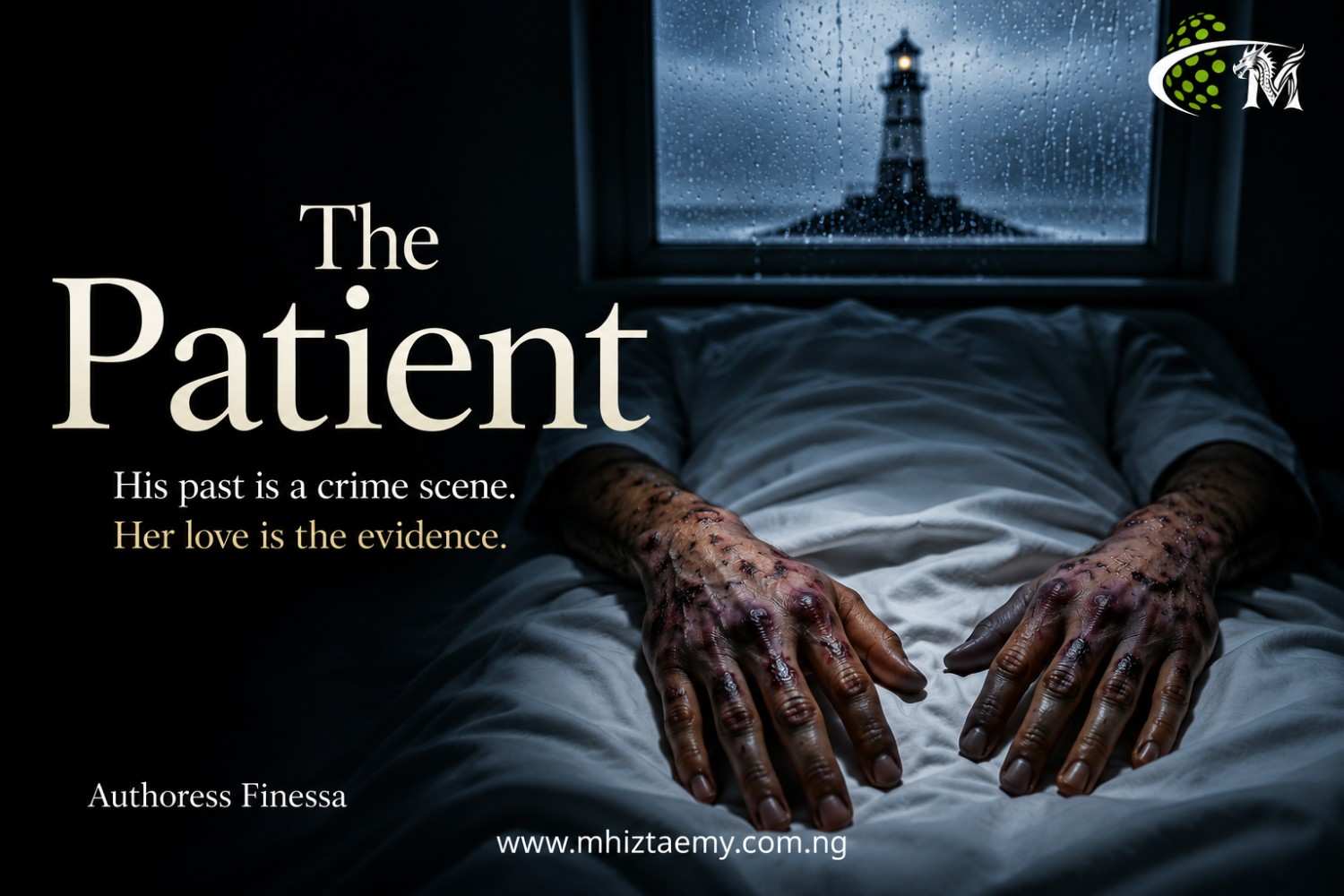
THE PATIENT
The Patient – Chapter 2
Theme: the violence of willful blindness. How much truth are we willing to sacrifice for love?
Settings: port Amber, Port Amber, a fictional gray coastal city. St. Dymphna’s Hospital. The ghost town of Blythe in the northern hills.
Genre: dark romantic suspense•••••
Mystery:What really happened in Blythe? Where is Clara? And is the man in Willa’s care a survivor, a savior, or a monster?
Tags: gothic romance, missing child, anti heroine protagonist, forced proximity••••
® FINESSA.
♣♣♣♣♣♣♣♣♣♣♣♣♣♣♣♣♣♣♣♣♣♣♣♣♣♣♣♣♣♣♣♣♣♣♣
The Lie
The rain stopped at dawn.
Related Posts
Willa watched it happen from the window of the fourth-floor break room, a cup of cold coffee cradled in her hands. The gray lifted slowly, grudgingly, like a curtain raised by someone who resented the performance. Below, the harbor emerged in fragments—a crane, a rusted trawler, the slick black ribbon of Meridian Street reflecting the first pale light. Port Amber looked like a photograph developing in water, all blurred edges and muted tones.
She had not slept. She had not gone home. She had sat in that vinyl chair beside his bed until the night nurse, a stout woman named Gloria who had seen everything twice, shooed her out at five in the morning with a look that was equal parts pity and warning.
“Don’t get attached, Willa,” Gloria had said. “They come in broken and they leave broken and you’re still the one who has to clean up the pieces.”
Willa had smiled, nodded, and lied with the ease of long practice. “I’m not attached. Just curious.”
Gloria had snorted. “Curiosity killed the cat.”
“But satisfaction brought it back,” Willa had replied, and the older woman had shaken her head and walked away, her sensible shoes squeaking on the linoleum like a reprimand.
Now, standing at the window, Willa replayed the word he had spoken. Clara. She had turned it over in her mind a hundred times since midnight, examining it from every angle like a jeweler inspecting a stone for flaws. It wasn’t the name itself that haunted her. It was the way he had said it. The raw, desperate tenderness. The way his ruined hands had twitched on the sheet, reaching for someone who wasn’t there.
A daughter, she thought. Or a sister. Or a victim.
She needed to know which.
The door to the break room swung open, and Willa didn’t have to turn around to know who it was. The energy in the room shifted, the way it always did when Detective Maren Cross entered a space. It was a peculiar talent, Willa thought—the ability to make a room feel smaller simply by standing in it.
“Nurse Calloway.”
Willa turned. Detective Cross was a woman in her late forties, with close-cropped silver hair and eyes the color of slate. She wore a rumpled trench coat over a black turtleneck, and she looked like she hadn’t slept either, though Willa suspected it was a more permanent condition with her. Some people were built for exhaustion. Some people were built by it.
“Detective,” Willa said.
“He’s stable?”
“He’s alive.”
Cross nodded, stepping into the room and letting the door swing shut behind her. She didn’t sit. She never sat. Willa had encountered her twice before, on other cases, other bodies, other nights when the hospital became a waystation between violence and consequence. Cross was the kind of detective who didn’t ask questions she didn’t already know the answers to. Willa filed that away.
“Did he say anything?” Cross asked.
The lie was ready before Willa consciously decided to tell it. It rose from some deep, instinctual place, a well she had dug years ago and never managed to fill in. “Nothing coherent. He’s been unconscious since he arrived. The head trauma is significant.”
Cross studied her for a long moment. The fluorescent light buzzed overhead. Somewhere down the hall, a patient moaned in drug-addled sleep.
“There were four bodies up there,” Cross said finally. “In a town called Blythe. You ever heard of it?”
“No.”
“Nobody has. It’s not on any map anymore. Logging town, abandoned in the sixties. The kind of place people go to disappear.” Cross paused. “Or to make someone disappear.”
Willa kept her face still. “And he’s the only survivor?”
“He’s the only one we found alive. Whether that makes him a survivor or a suspect depends on what he tells us when he wakes up.” Cross stepped closer, her shoes making no sound on the linoleum. She had a quiet tread, the kind that spoke of years of walking into rooms where things had gone terribly wrong. “You’ll let me know when that happens.”
It wasn’t a question.
“Of course,” Willa said.
Cross held her gaze for a beat too long. Then she turned and walked to the door, pausing with her hand on the frame. “There was something else. Something strange.”
Willa waited.
“We found a child’s backpack in the vehicle with him. Pink. Unicorn on the front. No child. No sign of a child anywhere in Blythe.” Cross looked over her shoulder, her gray eyes unreadable. “If he says anything about a kid, anything at all, you call me immediately. Not in an hour. Not after your shift. Immediately.”
Willa felt the name burning on her tongue. Clara. She swallowed it like a pill.
“Understood,” she said.
Cross left. The room expanded again, filling with silence and the pale, watery light of morning. Willa stood perfectly still for a full minute, her heart beating hard against her ribs. Then she threw her cold coffee in the trash and walked back toward the ICU.
—
He was awake.
She knew it before she reached the door. There was a quality to the silence in the room, a charged, watchful stillness that hadn’t been there before. She pushed the door open and found him exactly as she had left him—hooked to monitors, wrapped in white sheets, his battered face turned toward the window. But his one unswollen eye was open now, and it was fixed on her.
That eye. It was a color she couldn’t name—hazel, maybe, or something deeper, older, a shade that belonged in forests and forgotten places. It tracked her as she entered, calm and steady, entirely without the confusion she would have expected from a man who had woken from a coma to find himself in a stranger’s body.
“Good morning,” she said, keeping her voice light, professional. “I’m Willa. I’m one of the nurses taking care of you. Do you know where you are?”
He looked at her for a long moment. Then his cracked lips parted, and his voice came out in a dry whisper, like leaves scraping across pavement.
“I know where I’m not,” he said.
The answer was so unexpected, so strange, that Willa felt a shiver move through her. “Where aren’t you?”
“Wherever it is they want me to be.” He blinked slowly, and when his eye opened again, something in it had shifted. A recognition, maybe. Or a calculation. “You’re the one who stayed.”
Willa’s mouth went dry. “You were conscious?”
“No.” He lifted his hand—the fighter’s hand, the bruised and split knuckles—and looked at it as if it belonged to someone else. “But I knew you were there. I could feel it. In the dark. You were the thing that didn’t leave.”
She should say something professional. Something about hospital policy, about the detectives, about the questions she was supposed to be asking. Instead, she heard herself say, “You said a name. In your sleep.”
He lowered his hand. His gaze sharpened, and for the first time, Willa saw something flicker behind the calm—something quick and fierce and desperate. “What name?”
“Clara.”
The effect was immediate. His body went rigid, his jaw tightening, his hand gripping the sheet with a force that turned his knuckles white. The heart monitor skipped, a single erratic beep, before settling back into its steady rhythm.
“Do you remember her?” Willa asked softly.
He closed his eye. When he opened it again, the fierce thing was gone, locked away behind that unnerving calm. But his voice, when he spoke, was barely a whisper.
“I remember that she’s mine. And I remember that she’s in danger.”
He turned his head on the pillow, fixing Willa with that unreadable, ancient gaze.
“Are you going to help me?”
Willa stood in the gray morning light, the monitors humming their quiet songs, the detective’s warning still echoing in her ears. A child’s backpack. Pink. Unicorn on the front. A town that didn’t exist. Four bodies and a man who remembered only one thing with absolute clarity: a girl named Clara, and the fact that she needed him.
She thought of her ex-husband’s hands. The way they had looked before a blow. The way she had always believed, against all evidence, that she could save him from himself.
“I don’t know who you are,” Willa said. “I don’t know what you’ve done.”
He held her gaze. “Does that matter?”
She didn’t answer. But she didn’t leave either.
And somewhere, in a town called Blythe, in a house with a sagging porch and a door that had been left open to the rain, a pink backpack sat on a kitchen table. It was empty. It had been empty for three days.
But the chair beside it was pulled out, as if someone had just stood up and walked away.
As if someone was coming back.
It’s okay right?

13 Comments
Why can’t you make the story understandable,it’s confusing
Like seriously
I swear I dont understand this story at all.
Even looking at the story give me a serious headache.
This story is not confusing ,just trilling u just have to fall in the story just like i’m doing .everything just talking about a mysterious guy.afterall it’s just the beginning of the story.
Omor!! This story is really nice and captivating, i don’t know what u guys are complaining. Next pls.
Please,what is this,wetin Naigeria do to deserve all this.first was the bagpack was in the vechile,second was the bagpack was on the chair inside the kitchen,which one we wan belief,are you planning to turn our brain upside down.
Nawow!Wahala deyooo
Problem dey
Next
Hmmmm,let me manage it
I can’t continue reading the story it confusing pls don’t you read sweet sin or holy mary pls i need another story
Pls i can’t continue this story, guys go and read sweet sin
This story is unexpected like seriously I await what to come