

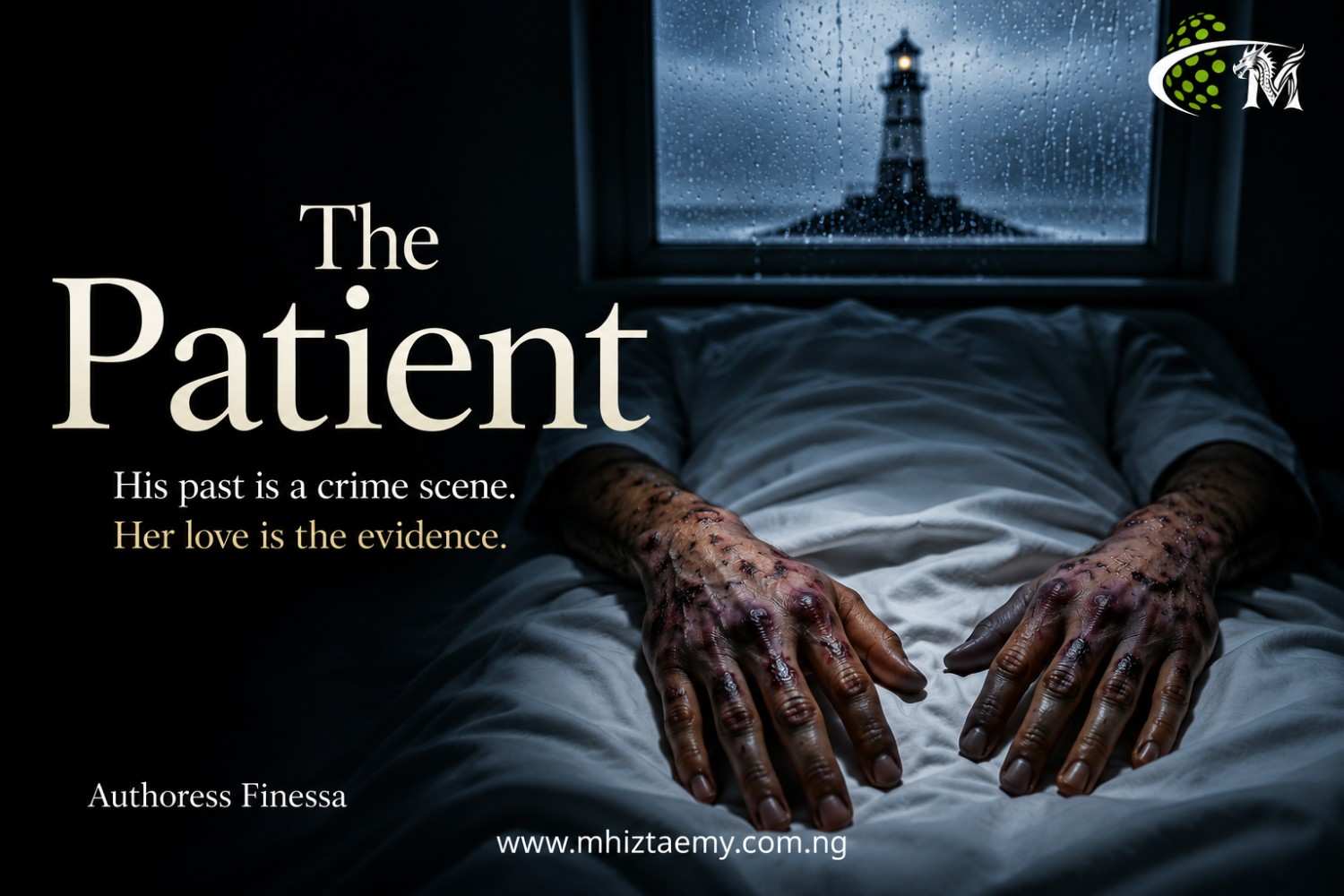
THE PATIENT
The Patient – Chapter 38
Theme: the violence of willful blindness. How much truth are we willing to sacrifice for love?
Settings: port Amber, Port Amber, a fictional gray coastal city. St. Dymphna’s Hospital. The ghost town of Blythe in the northern hills.
Genre: dark romantic suspense•••••
Mystery:What really happened in Blythe? Where is Clara? And is the man in Willa’s care a survivor, a savior, or a monster?
Tags: gothic romance, missing child, anti heroine protagonist, forced proximity••••
® FINESSA.
♣♣♣♣♣♣♣♣♣♣♣♣♣♣♣♣♣♣♣♣♣♣♣♣♣♣♣♣♣♣♣♣♣♣♣
The Ties That Bind
Summer arrived in Port Amber like a slow, warm exhale.
Related Posts
The fog that had defined so much of Willa’s life in the city retreated entirely, replaced by long golden days and gentle evenings that smelled of salt and roses. The harbor glittered with sunlight. The fishing boats came and went with their holds full. The tourists arrived, wandering the old streets with cameras and ice cream cones and expressions of pleasant bewilderment.
And in the Victorian house on the eastern edge of the city, life continued its quiet, joyful rhythm.
Clara had turned ten. She had insisted on a dragon-themed party—again—but this year she had added a new element: a book swap. Every guest was required to bring a favorite book to exchange, and Clara had given a copy of her own book to each of them, signed with a flourish and a small drawing of Horace.
“Next year I’m going to do a sea monster theme,” she announced at the end of the party, surveying the wreckage of cake and wrapping paper. “I’ve been researching. Did you know there’s a sea monster in Port Amber harbor? It’s called the Amber Serpent. It’s very shy.”
“I’ve lived here for years and I’ve never heard of it,” Willa said.
“That’s because it’s shy,” Clara repeated patiently. “I told you.”
Elias, sitting on the porch with his father, watched his daughter organize her new books with the efficiency of a tiny librarian. “She gets that from you,” he said to Marcus.
“The organizational skills? Definitely not. I spent four years hiding in a lighthouse. My organizational skills consist of ‘don’t die’ and ‘remember the password.'”
“The imagination, then. The belief in monsters that turn out to be friendly.”
Marcus was quiet for a moment. “She gets that from her mother. Lydia always saw the world differently. Even before the fire. Even before everything.” He paused. “She painted a mural in Clara’s nursery. When Clara was a baby. A whole wall full of dragons and unicorns and sea serpents. She said she wanted Clara to grow up believing the world was full of magic.”
“It is,” Elias said quietly. “Just not the kind we expected.”
—
Lydia’s second art show opened in July, and it was even bigger than the first.
This one was called Horizons, and it featured a series of paintings that traced the family’s journey from darkness into light. The first canvas was dark and chaotic—a burning mansion, a lighthouse in a storm, figures running through shadows. But as the series progressed, the colors brightened. The storms calmed. The figures stopped running and started standing still.
The final painting was the largest of all. It showed the Victorian house on the eastern edge of the city, its windows glowing with warm light, its porch full of people. Marcus was in a rocking chair. Lydia was painting at an easel. Clara was chasing a dragon made of imagination across the garden. Elias and Willa were standing hand in hand, looking out at the harbor. And in the distance, barely visible, was the lighthouse—no longer dark, but lit from within.
“I call it Home,” Lydia said, standing beside the painting as the gallery crowd murmured their appreciation. “It took me a long time to understand what that word meant. For years, home was something I was running from. Something I was hiding in. Something I was searching for. But now I know. Home isn’t a place. It’s the people who refuse to give up on you.”
Clara, standing beside her mother, tugged on her sleeve. “That’s us, right? In the painting?”
“That’s us.”
“Even Horace?”
“Even Horace.” Lydia knelt down to her daughter’s level. “He’s the little blur of green in the garden. See?”
Clara studied the painting. Then she nodded, satisfied. “Good. He would have been sad if you forgot him.”
“Dragons have feelings too.”
“Exactly.” Clara looked up at the painting again, her dark eyes thoughtful. “Mama? Do you think we’ll ever have to run again? From bad people, like before?”
Lydia felt her heart clench. “No, little bird. The bad people are gone. For good this time. We don’t have to run anymore.”
“Promise?”
“Promise.” Lydia pulled Clara into a hug. “We’re home now. For real. Forever.”
—
That same month, Cross announced her retirement.
She told them over dinner at the Victorian house, her expression as unreadable as ever. “I’ve been a detective for twenty-five years,” she said. “Lieutenant for three. I’ve closed more cases than I can count. But the Circle was the one that mattered most. And now that it’s done—really done—I think it’s time for something new.”
“What will you do?” Willa asked.
“Travel. Read. Sleep past six in the morning.” Cross almost smiled. “I might write a book. About the investigation. About Eleanor. About all of it.”
“You should,” Elias said. “People need to know what happened. What the Circle did. What we all did to stop them.”
“Maybe. But it won’t be a police procedural. It’ll be a story about people. About the choices they make. About the ones who fall and the ones who get back up.” She looked around the table—at Willa, at Elias, at Clara, at Lydia, at Marcus. “About the family that refused to give up on each other.”
Clara, who had been quietly coloring, looked up. “If you write a book, will you put Horace in it?”
“Absolutely. He’s a key witness.”
“Good.” Clara resumed coloring. “He’ll like that. He’s been feeling left out.”
—
The letter from the medical board arrived in August, exactly two years after Elias’s license had been provisionally reinstated.
He opened it with steady hands, Willa beside him, Clara perched on the arm of the couch with Horace in her lap.
Dear Dr. Thorne,
After a thorough review of your case, including your exemplary record over the past two years, your commitment to underserved communities, and the numerous letters of support submitted on your behalf, the board has voted to remove all remaining restrictions from your medical license.
You are now a fully licensed surgeon in the state, with no conditions or oversight requirements. Your license is permanent and unrestricted.
We commend you on your dedication to healing and your commitment to atonement. You are an example of what rehabilitation can achieve.
Sincerely,
The State Medical Board
Elias read the letter twice. Then he set it down on the coffee table and stared at it.
“Daddy?” Clara’s voice was uncertain. “Are you okay?”
“I’m more than okay, little bird.” His voice was rough. “I’m free.”
“You were always free,” Willa said quietly.
“I know. But now it’s official. No more oversight. No more restrictions. No more proving myself every single day just to keep a license that could be taken away at any moment.” He looked at her, his eye bright with emotion. “I’m a surgeon again. Fully. Completely. Without conditions.”
“You’ve been a surgeon this whole time. The conditions didn’t change that.”
“No. But they reminded me of it. Every day. Every surgery. Every patient.” He picked up the letter and read it again. “Now they’re gone. And I’m still here. Still healing. Still choosing to be better.”
“That’s because you’re not doing it to prove anything anymore,” Willa said. “You’re doing it because it’s who you are.”
Elias looked at her. Then at Clara. Then at his father, who was watching from the doorway with tears in his eyes.
“She’s right,” Marcus said quietly. “You’re not the man the Circle tried to make you. You’re not even the man who woke up in that hospital bed with no memory and no name. You’re someone new. Someone you chose to become.”
Elias stood and crossed the room. He embraced his father—the man who had given him away to monsters, the man who had spent years trying to make it right, the man who had shot one son to save another. “Thank you,” he said quietly. “For believing in me. Even when I didn’t believe in myself.”
“You’re my son,” Marcus said, his voice cracking. “I never stopped believing in you. I just stopped believing in myself. But you taught me how to find that again.”
“We taught each other.”
They stood there for a long moment, father and son, the weight of decades finally lifting. And in the living room behind them, Clara whispered to Horace, “See? I told you. Happy endings are real. You just have to fight for them.”
—
