

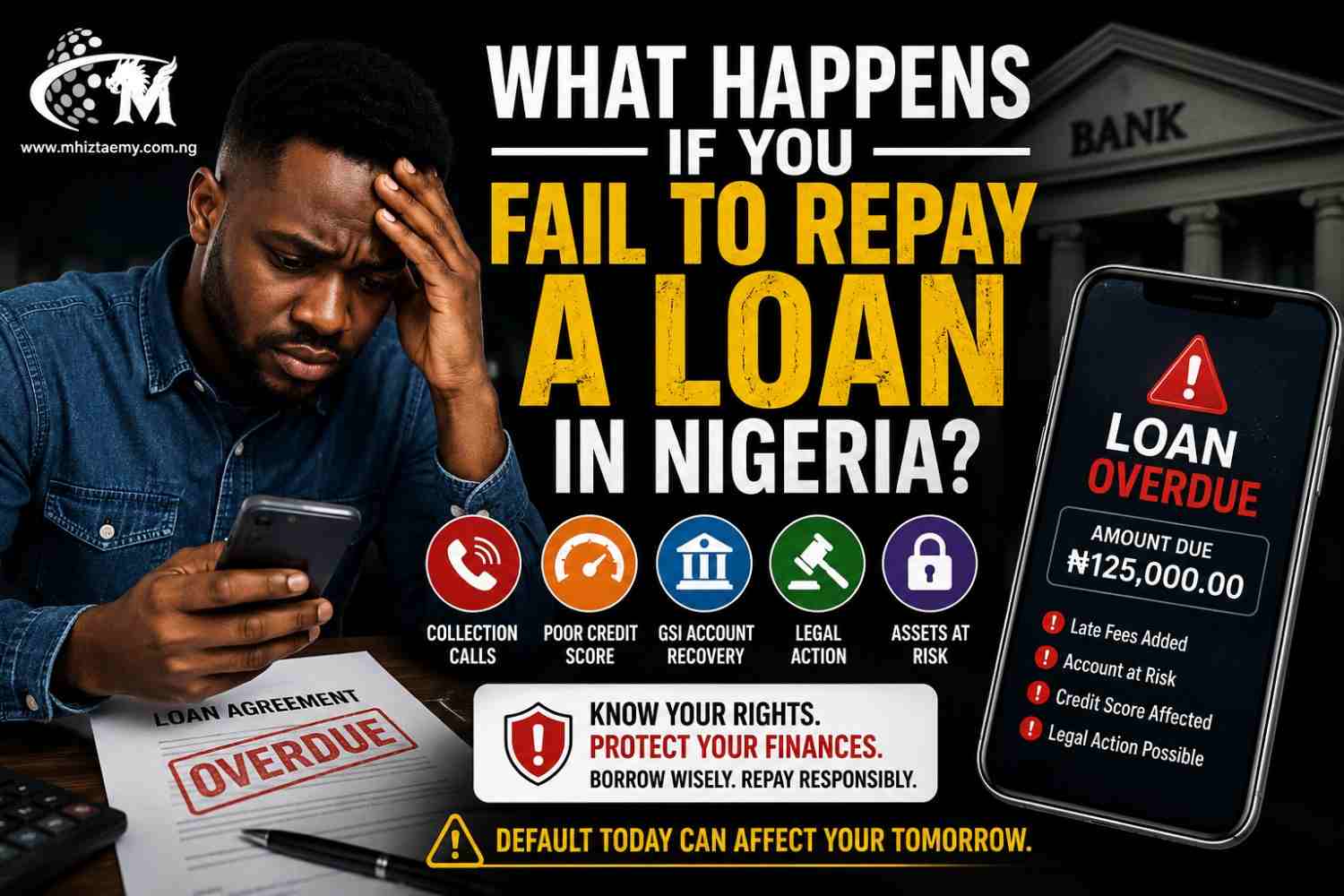
Taking a loan can help you handle an emergency, grow a business, pay school fees, cover rent or manage an unexpected expense. The problem starts when the repayment date arrives and you do not have enough money to pay. At that point, many Nigerians begin asking the same question: What happens if I fail to repay a loan in Nigeria?
Loan default can lead to more than repeated calls from a lender. Depending on the type of loan, the terms you signed and the lender involved, you could face additional charges, collection efforts, negative credit information, restrictions on future borrowing, recovery from qualifying bank accounts under a valid Global Standing Instruction (GSI), or legal action.
This article explains what can happen after a loan repayment is missed, what lenders can legally do, what digital loan apps are restricted from doing, and what you should do if you can no longer afford your repayments. The Central Bank of Nigeria (CBN) states that customers have a duty to repay credit facilities according to agreed terms and that delayed repayment can lead to default charges.
What Does It Mean to Default on a Loan in Nigeria?
A loan default generally occurs when a borrower fails to make a required repayment according to the agreement signed with the lender. A missed payment does not always mean the entire loan immediately becomes due, because the exact consequences depend on the loan contract, repayment schedule and lender’s policies.
Some lenders may first send reminders and allow a short period for payment. Others may apply a late-payment charge immediately if the agreement permits it. Continued non-payment can lead to more serious recovery measures.
The first thing you should do after missing a repayment is check your loan agreement. Look at the outstanding principal, interest, late charges, repayment dates, grace period and any recovery authorization you accepted when taking the loan.
What Happens If You Fail to Repay a Loan in Nigeria?
The consequences can develop gradually rather than happening all at once. A person who misses one repayment may receive reminders, while someone who ignores the debt for several months may face credit-reporting consequences and stronger recovery action.
The table below gives a general picture of what may happen.
| Stage of Loan Default | What May Happen | What You Should Do |
|---|---|---|
| Payment is missed | Reminder messages, calls or emails | Contact the lender quickly |
| Short-term default | Late charges may apply if permitted | Request the exact outstanding balance |
| Continued default | More collection activity | Negotiate a repayment arrangement |
| Serious default | Negative credit information may be reported | Check your credit report |
| Long-term default | Formal debt recovery or legal action may occur | Seek legal or financial advice |
| Loan with GSI mandate | Eligible funds in qualifying accounts may be recovered | Review your loan agreement and GSI mandate |
| Secured loan default | Security or collateral may become subject to enforcement | Contact the lender before enforcement progresses |
The actual process differs from one loan product to another, so borrowers should not assume that every lender follows exactly the same sequence.
1. You May Receive Calls, SMS and Repayment Reminders
The first response to a missed loan repayment is often communication from the lender. You may receive SMS messages, emails, phone calls or notifications through the lender’s application.
Related Posts
- How to Get a NIRSAL Loan in Nigeria in 2026: Requirements, Benefits and Application Process
- SMEDAN Support Programs in Nigeria: How Entrepreneurs Can Access Training, Grants, Loans, and Business Growth Opportunitie
- How to Apply for a NIRSAL Microfinance Bank (NMFB) Loan in Nigeria: Complete Step-by-Step Guide
- Fish Farming Loans and Aquaculture Grants in Nigeria: How to Secure Funding Fast and Start Profitable Fish Farming Without Stress
- Step-by-Step Guide: How to Apply for SMEDAN Support Programs in Nigeria (2026)
The lender may remind you about the amount outstanding and request payment. Some lenders may also explain the consequences of continued non-payment.
CBN consumer-protection materials state that financial institutions should use fair and ethical debt-recovery practices and engage consumers before recovery action begins.
Ignoring every communication can make the situation harder to resolve. A better option is to respond and explain your financial position while requesting an updated statement showing exactly what you owe.
2. Late Fees or Default Charges May Be Added
Missing your repayment date can increase the amount you eventually have to pay if your agreement permits late fees or other default charges.
A borrower should not assume that the amount originally borrowed is automatically the final amount owed. Interest, approved charges and other contractual costs can affect the balance.
Check the original loan agreement and repayment schedule before making a payment. If the amount demanded appears different from your records, ask the lender to provide a written breakdown of the principal, interest, late charges and any other fees.
3. Your Credit Record Can Be Affected
One of the longer-term consequences of loan default is damage to your credit profile.
Nigeria has a credit-reporting system that allows credit information to be collected and used when lenders assess applications. The CBN says its Credit Risk Management System was established to support credit information sharing and help financial institutions assess borrowers’ repayment capabilities.
The Credit Reporting Act also provides a framework for credit bureaux and credit information sharing in Nigeria. CBN materials explain that credit bureaux maintain databases of credit-related information and issue credit reports for permitted purposes.
This means a history of missed or unpaid loans can make future borrowing more difficult.
Can a Loan Default Affect Your Credit Score in Nigeria?
Yes. A lender may report relevant credit information through the applicable credit-reporting system. A poor repayment history can make another lender more cautious about approving your application.
A person with an unpaid loan may therefore find it harder to obtain another personal loan, business loan, credit facility or other financial product.
The effect depends on the lender, the credit information available and the particular application. It is not accurate to assume that every missed payment automatically produces the same score reduction for every borrower.
4. Getting Another Loan May Become More Difficult
Suppose you borrow ₦300,000 and stop making repayments. Later, you apply to another financial institution for ₦1 million.
The second lender may review your existing credit obligations before deciding whether to approve the new application. A record showing unpaid or poorly serviced debt can reduce your chances of approval or affect the terms offered.
CBN explains that credit information helps financial institutions assess repayment capacity and that borrowers who meet their obligations can continue to have access to credit, while delinquent borrowers can face restrictions on new facilities.
Taking another loan simply to cover an old unpaid loan can also create a debt cycle. The safer option is usually to calculate your total obligations first and discuss repayment options with the existing lender.
5. A Bank Could Recover Eligible Funds Through GSI
One of the most important issues Nigerian borrowers should know about is the Global Standing Instruction, commonly called GSI.
GSI is a mechanism used within the Nigerian banking system to recover eligible past-due loan obligations from qualifying accounts held with participating financial institutions. NIBSS describes GSI as a mechanism that allows banks to recover loan defaults from a borrower’s accounts across multiple banks.
The CBN’s GSI framework provides for recovery of past-due principal and accrued interest from qualifying accounts, while penal charges are excluded from the GSI recovery amount. Eligible account types can include savings, current, domiciliary, investment or deposit accounts and electronic wallets, subject to the applicable rules and mandate.
Example of How GSI Can Work
Imagine that Emeka takes a bank loan and signs the required GSI mandate as part of the loan documentation. He later defaults and still has ₦200,000 sitting in another qualifying bank account.
If the loan and mandate fall within the GSI framework, the creditor bank may initiate the permitted recovery process through the banking system. This means moving money between banks does not necessarily make an eligible default disappear.
GSI should not be confused with every type of digital lending arrangement. Its application depends on the lender, facility, mandate and applicable regulatory requirements.
6. Your Collateral Could Be at Risk
Some Nigerian loans are secured against assets.
A mortgage may involve property. A vehicle loan may involve a vehicle. A business facility may involve equipment, inventory or another form of security.
Failing to repay a secured loan can eventually lead to enforcement against the security, subject to the loan agreement and applicable law. The exact process depends on the type of security, the documentation and the legal procedures involved.
This is one reason borrowers should act early rather than waiting until the lender starts formal recovery proceedings.
7. A Guarantor Could Become Involved
Some loans require a guarantor. A guarantor may agree to take responsibility under specific conditions if the borrower fails to meet the obligations.
The consequences depend on the guarantee document that was signed. A guarantor should therefore read the terms carefully before accepting responsibility for another person’s loan.
Borrowers should also avoid assuming that a guarantor can simply be ignored after default. If the agreement creates enforceable obligations, the lender may take steps permitted under the agreement and applicable law.
8. The Lender Could Take Legal Action
A lender may use lawful debt-recovery procedures when a borrower continues to refuse or fail to repay.
Legal action does not mean that every person who misses one payment will immediately be taken to court. Lenders normally consider the size of the debt, repayment history, contract terms, recovery efforts and other circumstances.
A court process can create additional costs, stress and delays. Receiving a formal legal notice should therefore be treated seriously rather than ignored.
If you receive court documents relating to a loan, obtain advice from a qualified Nigerian lawyer and respond within the required timeframe.
Can You Be Arrested Simply Because You Failed to Repay a Loan?
A simple inability to repay an ordinary civil debt should not automatically be treated as a criminal offence.
Loan default can result in civil recovery processes, credit consequences and other lawful actions. Criminal liability can arise where separate conduct involves an offence, such as fraud or obtaining money through deceptive means, but that is different from simply being unable to meet an agreed repayment date.
Borrowers should therefore avoid panic when receiving legitimate recovery communications. At the same time, they should not ignore formal legal documents or assume that a debt can simply disappear.
Can a Loan App Contact Your Friends and Family?
This area requires particular attention because digital lending has generated many complaints about privacy violations and abusive collection practices.
The FCCPC’s digital lending framework addresses consumer protection, transparency, data protection and debt-collection conduct. The Commission states that digital lenders must comply with applicable consumer and data-protection requirements, and it identifies public shaming, intimidation and privacy breaches as abuses that the regulatory framework is intended to address.
A lender does not receive unlimited permission to harass people simply because you owe money. The FCCPC has previously directed digital lenders under investigation to stop contacting people on borrowers’ contact lists or third parties and to stop abusive or coercive communication.
What Should You Do If a Loan App Threatens or Harasses You?
Save screenshots of messages, call records, payment demands, account details and other evidence.
Do not delete evidence simply because the messages are embarrassing. Keep copies showing the lender’s name, phone numbers, dates, amounts demanded and the exact language used.
You can also report unlawful conduct through the appropriate regulatory complaint channels. The FCCPC currently maintains information on approved digital lenders and consumer complaints relating to digital lending.
The regulatory position around digital lending has also changed recently. FCCPC stated in July 2026 that implementation of the DEON Regulations resumed after the Federal High Court judgment that vacated the earlier restraining order.
What Happens If You Cannot Repay a Loan Because You Lost Your Job?
Losing your job, experiencing reduced income or dealing with an unexpected financial emergency can make a previously affordable loan difficult to service.
The worst response is usually to disappear completely.
Contact the lender as soon as you know that your next repayment may fail. Explain the situation, ask for the current balance and request information about any restructuring, revised repayment schedule or other available arrangement.
A lender may not approve every request, but early communication gives you an opportunity to discuss the situation before the debt becomes more difficult to manage.
What to Do If You Know You Cannot Repay Your Loan
Step 1: Stop Taking New Loans to Hide the Problem
Taking another expensive loan to pay an existing loan can create a cycle that becomes increasingly difficult to escape.
Write down every outstanding loan, the balance, interest, repayment date and monthly amount. Seeing the entire picture can help you decide which obligations require immediate attention.
Step 2: Calculate Exactly What You Owe
Do not rely only on memory or an old SMS.
Request a current loan statement from the lender. Confirm the principal outstanding, accrued interest, late charges and payment history.
Keep screenshots and receipts for payments you have already made.
Step 3: Contact the Lender
Tell the lender that you are experiencing difficulty and want to resolve the debt.
Ask whether the lender offers restructuring, a revised repayment schedule, temporary relief or another repayment arrangement. Get any agreed changes in writing.
Step 4: Prioritise Your Essential Expenses
Food, housing, transportation, healthcare, utilities and other essential household needs should be included in your financial plan.
After calculating these expenses, determine how much you can realistically allocate to debt repayment each month. Promising an amount you cannot afford may simply lead to another missed payment.
Step 5: Avoid Unlicensed Loan Apps
An urgent financial problem can make another quick loan look attractive.
Check the lender’s regulatory status before borrowing again. The FCCPC maintains information on digital lenders and advises consumers to check approved lenders and loan terms.
Step 6: Keep Every Record
Save your loan agreement, repayment receipts, emails, SMS messages, statements and screenshots.
These records can become important if you later dispute the amount claimed or need to report inappropriate collection behaviour.
What If the Lender Says You Owe More Than You Borrowed?
Borrowing ₦100,000 does not necessarily mean the final amount payable will remain ₦100,000.
Interest and permitted charges may form part of the contractual repayment obligation. However, you should be able to identify how the amount was calculated from the loan agreement and account statement.
Ask the lender to provide a written calculation if you believe the amount is incorrect.
A dispute over the balance should be handled through the lender’s complaint process and, where appropriate, the relevant regulator or court.
What If You Already Paid the Loan but the Lender Still Shows You as a Defaulter?
This situation can occur when a payment has not been correctly posted or when credit information has not been updated.
Gather your payment receipt, transaction reference, bank statement and loan account details. Contact the lender and request correction of the account.
If the lender is a CBN-regulated financial institution and does not resolve your complaint, CBN provides a complaint escalation process. Its guidance says customers should first complain to the financial institution and can escalate to the CBN Consumer Protection Department if the institution fails to resolve the complaint within the applicable timeframe.
Can You Still Get a Loan After Defaulting?
Yes, a previous default does not necessarily mean you can never borrow again.
Your future access to credit can depend on the outstanding debt, repayment history, credit information, income, existing obligations and the lender’s credit assessment.
Paying the outstanding debt and ensuring that your records are correctly updated can help improve your position. It is also wise to avoid immediately applying for several loans at once.
How Long Does a Loan Default Stay on Your Credit Record in Nigeria?
There is no single simple answer that applies to every type of credit record and every situation.
Credit information is governed by Nigeria’s credit-reporting framework, and the treatment of information can depend on the applicable law, reporting rules and the records maintained by credit information providers.
Anyone concerned about an inaccurate credit record should obtain their credit report and check the entries carefully. Errors should be challenged with the relevant credit information provider and lender.
How to Protect Yourself Before Taking a Loan in Nigeria
Loan problems are often easier to prevent than to resolve.
Read the loan agreement before accepting the money. Check the total repayment amount, interest rate, fees, repayment dates, consequences of late payment, collateral requirements and any debit or recovery mandate.
A lender should provide clear information about the credit facility. CBN consumer-protection rules emphasise disclosure of credit terms such as pricing, repayment schedule, repayment amount and tenure.
Ask These Questions Before Borrowing
| Question | Why It Is Important |
|---|---|
| How much will I repay in total? | Shows the actual cost of the loan |
| What is the repayment date? | Helps you plan your cash flow |
| What happens if I pay late? | Reveals possible default charges |
| Is collateral required? | Shows whether an asset is exposed |
| Is there a GSI mandate? | Explains possible recovery from qualifying accounts |
| Will the loan be reported to a credit bureau? | Helps you assess credit-record consequences |
| Can the repayment schedule be changed? | Gives you an option if income falls |
| What happens after prolonged default? | Helps you assess the full risk before borrowing |
What Should You Never Do After Defaulting on a Loan?
Do not ignore the lender indefinitely.
Do not take multiple high-cost loans simply to pay earlier loans without calculating the total debt.
Do not provide false information to obtain another facility.
Do not delete payment evidence or communication records.
Do not send money to an unknown person who claims they can erase your loan without verifying the claim with the lender.
Do not allow abusive collection tactics to intimidate you into making unsafe financial decisions. Legitimate debt collection can occur, but consumers still have rights relating to fair treatment, privacy and complaint handling.
Frequently Asked Questions About Loan Default in Nigeria
What happens if I don’t repay a loan in Nigeria?
You may receive repayment reminders and collection calls, incur permitted late charges, have negative credit information reported, face restrictions on future borrowing and potentially face formal debt-recovery action. A GSI mandate may also allow eligible recovery from qualifying accounts in applicable cases.
Can a bank take money from another bank account because of a loan default?
A qualifying bank loan with an applicable GSI mandate can allow recovery from eligible accounts held with participating financial institutions. The GSI framework covers specified account types and is subject to its rules.
Can a loan app debit my account without permission?
The answer depends on the authorization, mandate and applicable rules governing the particular loan. Borrowers should examine the agreement and any debit mandate they accepted rather than assuming that every lender has unlimited access to their accounts.
Can loan apps call my contacts?
Digital lenders are subject to consumer-protection and data-protection requirements. Abusive contact with third parties, public shaming and privacy violations have been among the practices targeted by Nigerian regulators.
Can I be arrested for owing a loan?
Ordinary inability to repay a debt is different from criminal conduct. A lender may pursue lawful civil recovery, while separate allegations such as fraud can create different legal consequences.
Will defaulting on a loan affect my credit score?
A loan default can affect the credit information available to lenders. Credit bureaux and the CBN credit-reporting infrastructure are used to support credit assessment in Nigeria.
Can I get another loan after defaulting?
It is possible, but an unpaid or poorly serviced loan can reduce your chances of approval. Lenders may assess your existing obligations and repayment history before making a decision.
What should I do if I cannot afford my loan repayment?
Contact the lender early, request your current statement, explain your financial situation and ask about available repayment arrangements. Avoid taking another expensive loan without first calculating your total debt.
What happens if I ignore a loan company?
Ignoring the lender does not normally erase the debt. Collection activity may continue, credit consequences may arise and the lender may pursue other lawful recovery options available under the agreement and applicable law.
Can a lender sell my debt to a collection agency?
Some lending arrangements may allow debt recovery through third-party agents or collection arrangements, subject to applicable law and regulatory requirements. Borrowers should verify the identity of anyone demanding payment and request evidence of the debt and authority to collect it.
How can I check if a debt recorded against me is correct?
Request your credit report and compare the listed accounts, balances and repayment status with your own records. Dispute any inaccurate information with the relevant lender and credit information provider.
Conclusion
Failing to repay a loan in Nigeria can create consequences that extend beyond the original repayment date. You may face late charges, collection activity, negative credit information, reduced access to future borrowing, GSI recovery in applicable cases, collateral enforcement or formal legal recovery.
The smartest response to loan difficulty is not to hide from the lender. Check your agreement, calculate the exact amount owed, keep your payment records, communicate early and seek professional advice when the situation involves a legal dispute or substantial debt.
Borrowing should always be based on a repayment plan that fits your income. If you have already defaulted, taking action early can help prevent a temporary cash-flow problem from becoming a much larger financial burden.
To read more on loan program click www.mhiztaemy.com.ng
