

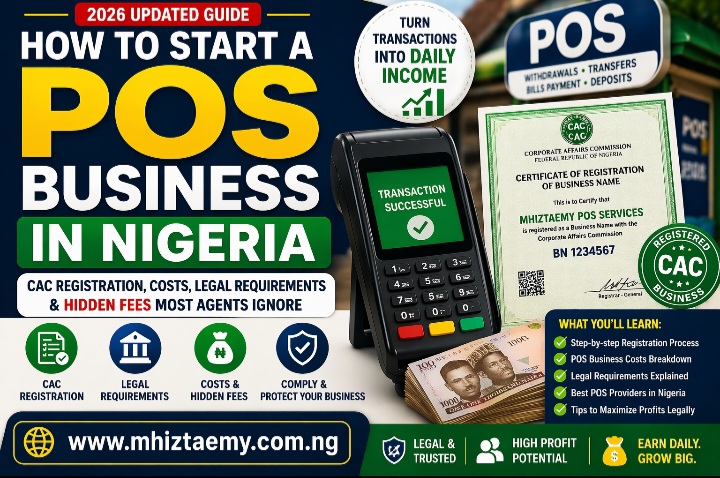
Starting a POS business in Nigeria is one of the fastest ways to generate daily cash flow, especially in busy areas where people need quick access to money. Demand keeps rising as more Nigerians rely on agents for withdrawals, transfers, and bill payments. Many new operators jump in because it looks easy, but a large number end up facing account restrictions, hidden charges, or low profits due to poor setup.
Anyone serious about earning steady income from POS must pay attention to registration, legal compliance, and the actual cost structure. Getting these parts right from the beginning gives a strong advantage, builds trust with customers, and attracts better transaction volume.
This guide explains the exact registration process, legal requirements, POS business cost in Nigeria, and the steps needed to start legally while maximizing profit potential.
What a POS Business Involves in Nigeria
A POS (Point of Sale) business allows individuals to act as agents for banks or fintech companies, providing services like cash withdrawals, deposits, transfers, airtime sales, and bill payments. Earnings come from transaction charges, and profit increases with volume and location.
Busy environments such as markets, junctions, campuses, and commercial areas generate higher daily income. Some agents earn between ₦5,000 to ₦20,000 daily depending on traffic and pricing strategy.
Many beginners fail not because the business is bad, but because they ignore cost structure, compliance rules, and provider differences.
POS Business Legal Requirements in Nigeria
Operating legally is not optional if long-term income is the goal. Financial institutions now monitor agents closely, and any suspicious activity can lead to account suspension or permanent ban.
Every POS operator must work under a licensed bank or fintech company approved by the Central Bank of Nigeria. This is known as agency banking. Independent operation without a provider is not allowed.
Proper identification such as BVN, NIN, and valid ID card is required during registration. These details are used to track transactions and prevent fraud.
Skipping compliance might seem harmless at the beginning, but it often leads to frozen funds and loss of business.
CAC Registration for POS Business in Nigeria
Registering a business name with the Corporate Affairs Commission (CAC) gives the POS business legal identity and improves credibility. It also increases approval chances when applying for multiple POS machines.
CAC Registration Process
The process starts by choosing a unique business name and checking availability on the CAC portal. After approval, business details are submitted, and a registration fee is paid.
Once completed, a certificate is issued. This document allows the operator to open a business bank account and access financial services.
CAC Registration Cost in Nigeria
The CAC registration fee for a business name usually ranges between ₦10,000 to ₦25,000 depending on service providers and processing method.
Many POS providers prefer agents with CAC registration because it shows seriousness and reduces risk.
Agents planning to scale into multiple locations or manage sub-agents benefit greatly from this step.
POS Machine Providers in Nigeria (Best Options)
Choosing the right provider directly affects profit, transaction speed, and customer satisfaction. Some providers offer better commission rates and fewer network issues.
Popular POS providers in Nigeria include Opay, Moniepoint, Palmpay, First Bank POS, and Access Bank POS. Each platform has different charges, settlement speed, and requirements.
Some agents make the mistake of choosing based only on popularity, then later struggle with hidden fees or poor network uptime. Comparing transaction charges before selecting a provider can increase long-term earnings.
POS Business Cost in Nigeria (Full Breakdown)
Starting a POS business requires moderate capital, and understanding the full cost helps avoid surprises.
Basic Startup Cost
Initial setup can range from ₦50,000 to ₦300,000 depending on location and provider. This includes registration, setup, and working capital.
POS Machine Cost
Many fintech companies provide POS machines for free but require a minimum transaction volume. Others may charge between ₦20,000 to ₦100,000.
Shop or Kiosk Setup
A small kiosk or shop space may cost between ₦10,000 to ₦50,000 monthly depending on location. High-traffic areas cost more but generate higher returns.
Working Capital
Cash availability is critical. Starting with at least ₦50,000 to ₦200,000 ensures smooth daily operations.
Hidden costs like network charges, reversals, and failed transactions can reduce profit if not properly managed. Many new agents ignore this and lose money silently.
Opening a Business Bank Account
A separate business account improves financial tracking and credibility. It also reduces the risk of mixing personal and business funds.
Banks require CAC documents, valid ID, utility bill, and passport photograph. Some fintech platforms offer wallets, but linking to a bank account adds stability.
Consistent transaction records can help when applying for loans or expanding the business.
KYC Compliance and Fraud Prevention
KYC (Know Your Customer) rules are strictly enforced in Nigeria. Agents must verify customer details during transactions to avoid fraud.
Large deposits and suspicious transfers should always be handled carefully. Ignoring these checks can result in account restrictions.
Many successful POS agents follow strict verification habits, which protects their accounts and builds long-term trust with customers.
Location Strategy That Increases Profit
Location determines income level more than anything else in the POS business. High foot traffic areas generate more transactions daily.
Markets, bus stops, and commercial streets are ideal. Quiet residential areas may struggle unless there is limited competition.
Some agents fail because they choose cheap locations with low demand. Paying slightly more for a busy spot often leads to higher profit.
Step-by-Step Guide to Start a POS Business Legally
Starting the business the right way increases approval chances and reduces risk.
Choose a business name and complete CAC registration to establish legal identity. Open a business bank account using the registration documents to manage transactions properly.
Apply for a POS machine through a licensed provider such as Opay or Moniepoint. Submit required documents and wait for approval.
Secure a good location with high customer traffic and set up your kiosk or stand. Ensure compliance with local government rules where necessary.
Start operations by maintaining proper transaction records, following KYC rules, and managing daily cash flow efficiently.
Consistency, honesty, and good customer service increase daily earnings and attract repeat customers.
Common Mistakes That Reduce POS Profit
Many operators lose money without realizing it due to avoidable mistakes.
Poor location choice limits daily transactions. Ignoring transaction charges reduces profit margins. Mixing personal and business funds creates confusion.
Failure to follow KYC rules leads to account restrictions. Choosing unreliable POS providers results in downtime and lost customers.
Avoiding these mistakes improves long-term success and income stability.
Frequently Asked Questions (FAQ)
How much does it cost to start a POS business in Nigeria?
The cost of starting a POS business in Nigeria ranges from ₦50,000 to ₦300,000 depending on the provider, location, and working capital.
Is CAC registration required for POS business?
CAC registration is not mandatory for a single POS machine, but it is highly recommended for agents planning to expand or operate multiple terminals.
Do I need a license to run a POS business in Nigeria?
A separate license is not required, but the business must operate under a licensed bank or fintech company approved by the Central Bank of Nigeria.
Which POS provider is best in Nigeria?
Opay, Moniepoint, and Palmpay are among the most popular due to their reliability, wide network coverage, and competitive transaction charges.
How much can a POS agent earn daily?
Daily earnings can range from ₦5,000 to ₦20,000 or more depending on location, transaction volume, and pricing strategy.
Conclusion
Starting a POS business in Nigeria remains a strong income opportunity, but real success comes from setting it up correctly. Registration with CAC, choosing a reliable POS provider, understanding the full startup cost, and following legal requirements all play a major role in long-term profitability.
Agents who pay attention to compliance, location, and transaction management tend to earn more and avoid costly issues like account suspension or hidden losses. Taking action with the right setup creates a stable business that can grow into multiple locations and higher daily income.
